Backcountry Snow
Remote Triggering And Why Distance Does Not Protect You
A weak layer can transmit a collapse across flat ground and up into steeper terrain, which is why avalanches are sometimes triggered by people standing nowhere near the slope.
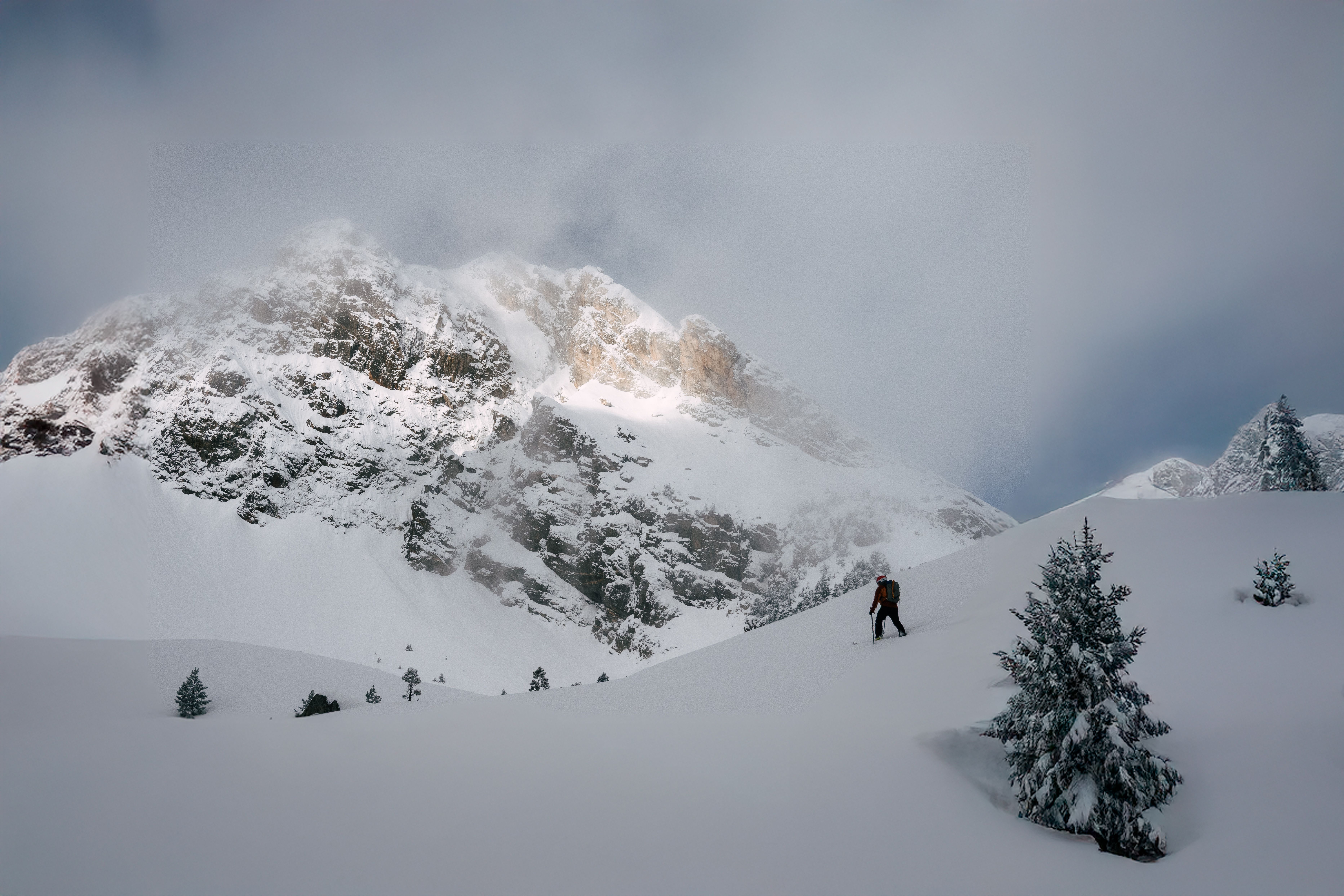
The intuitive model of an avalanche has a person on a steep slope causing it to fail beneath them. A significant share of accidents do not work that way at all.
Collapse can travel
Where a weak layer sits beneath a cohesive slab, the failure begins as a collapse of that layer under load. The collapse does not stay where it started.
It propagates outward through the weak layer, sometimes for a considerable distance, because the slab above it is stiff enough to carry the disturbance sideways.
If that propagation reaches ground steep enough to slide, the slab there releases. The person who triggered it may be standing somewhere entirely safe.
The audible warning
A collapsing weak layer often produces a deep whumpf, sometimes with cracks shooting away across the surface. This is the propagation happening under a person's feet.
On flat ground the collapse produces nothing more than the noise, which is why people occasionally treat it as a curiosity rather than as direct evidence.
It is the clearest possible signal that a propagating weak layer exists and is reactive to human loading on that day.
Triggering from below
Slopes have been released by people traversing the flat runout beneath them, skinning along a valley floor, or standing on a shallow ridge above the start zone.
Trigger points are also frequently thin spots in the snowpack, where a person's weight reaches the weak layer more effectively than it does in deep snow.
Those thin spots are often near rocks, at the edges of slopes or on convex rolls, which is why the same terrain features appear repeatedly in accident accounts.
Why persistent layers are the usual cause
Remote triggering is overwhelmingly associated with persistent weak layers such as buried surface hoar or faceted crystals, because those layers can transmit a collapse over distance.
Storm snow instabilities generally do not propagate the same way, which is why the problem type in a bulletin matters more than the danger number.
These layers can remain reactive for weeks or months, long after conditions look settled and the surface has stabilised.
What it changes about travel
The practical implication is that a safe position must account for what is above and connected, not just for the ground being stood on.
Runout zones, valley floors beneath large slopes and terrain connected to steep ground all deserve consideration when a bulletin describes a propagating problem.
Recognising connected terrain reliably requires avalanche training and the current regional forecast, since the layer at issue is invisible from the surface.
Also by Jonas Lindqvist
- How to read an avalanche forecast properlyBackcountry Snow
- Spring snow: wet slides, timing, and the shrinking windowBackcountry Snow
- Your first season of ski touring: what nobody warns you aboutBackcountry Snow
- Electronics in the cold: keeping the things you depend on aliveGear & Kit


